What is Low-E glass?
Low-E glass includes a microscopic metallic coating that changes how heat moves through the glazing.
This coating can:
- Reflect heat back into a room or away from a building
- Improve insulation performance
- Alter how solar energy is absorbed and distributed through the glass
That performance is useful, but it also means film selection and placement need to be handled more carefully than with standard clear glass.
Why internal film can be risky
When window film is installed on the internal surface of Low-E glass, heat behavior can change in a way that is not always safe for the glazing system.
In plain terms, this sequence can occur:
Solar energy passes through the glass.
The Low-E coating reflects heat back toward the glass.
The window film also absorbs and reflects heat.
Heat can become trapped within the glazing system.
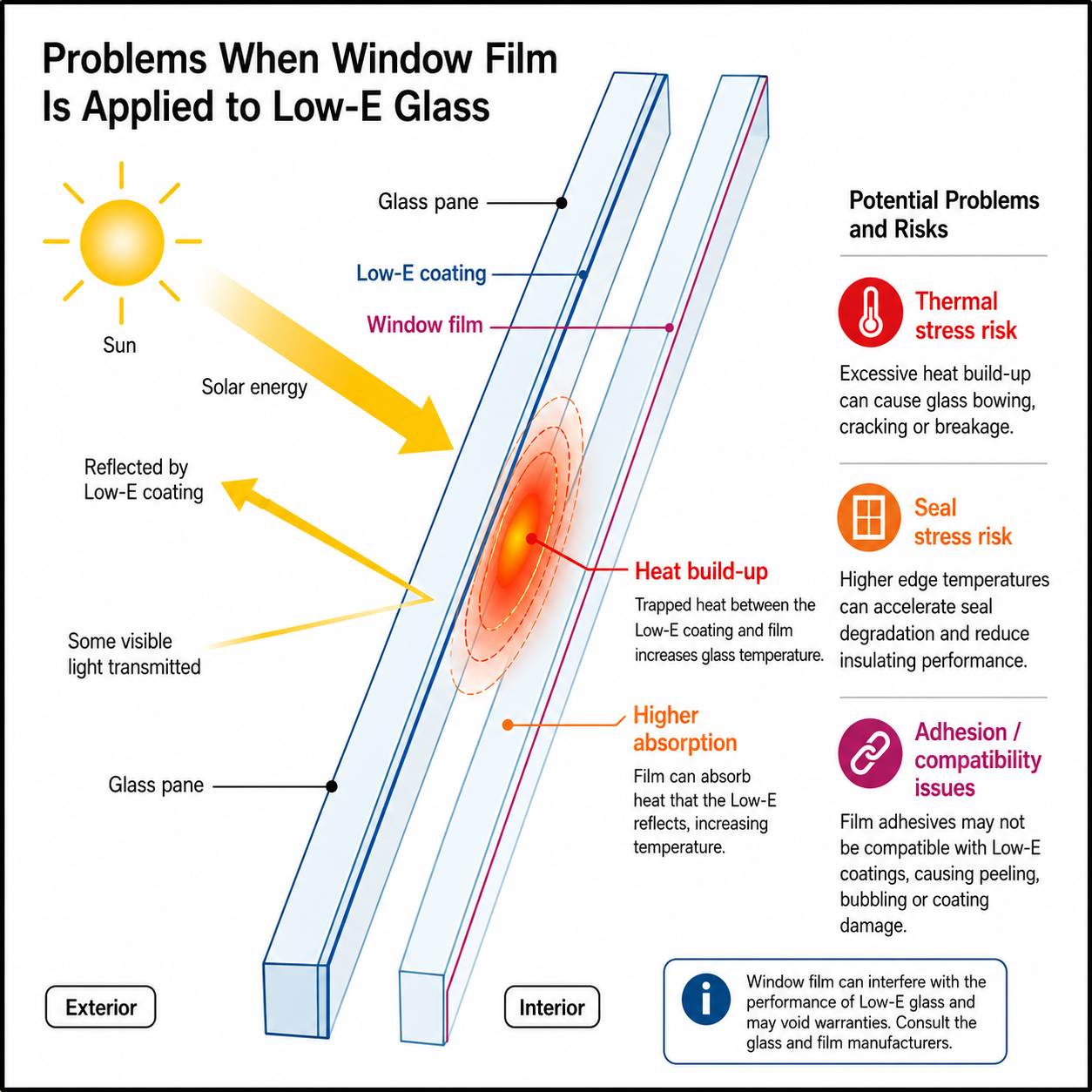
Instead of dispersing naturally, heat can build up inside the glass unit, especially in demanding exposures.
What thermal stress can cause
Glass expands when heated. If that expansion is uneven, stress builds across the pane.
Potential outcomes include:
This is one reason thermal compatibility checks are not optional on Low-E jobs. They protect the glass, not just the film decision.
Warranty implications
Risk and warranty notice
Before installing film on Low-E glass, check:
- Whether the glass manufacturer's warranty permits the proposed film
- Whether the film manufacturer's warranty covers the glass type and installation position
- What cover, conditions and exclusions apply to the proposed installation
Ultra Tint will not proceed with an installation that introduces avoidable risk.
Industry standards and suitable glass types
Professional window film work is expected to meet clear visual, performance, application and curing standards.
Those standards assume the film is being applied to suitable glass under suitable conditions. Low-E glass with internal film can fall outside those safe conditions, depending on coating position and glazing design.
Ultra Tint's approach
Not all glass is suitable for all films.
Ultra Tint prioritises the correct outcome over the convenient one. As a 3M Platinum Select Partner, our recommendations are based on field experience and manufacturer-level technical standards.
Knowing when not to install is just as important as knowing how.
Suitable alternatives
Alternative pathways for Low-E glazing
- External-grade window films designed for Low-E compatibility
- Spectrally selective films with lower heat absorption
- Adjusted film placement based on glazing configuration
- Product selection based on measured performance rather than appearance alone
Depending on the project, this can involve spectrally selective films and other performance-led options that reduce risk while still addressing heat and glare.
What this means for the client
If Ultra Tint advises against internal film on Low-E glass, it means:
- A genuine risk has been identified
- Your glass and warranty position are being protected
- The recommendation is based on long-term performance, not short-term installation convenience
Bottom line
We do not install film where it should not be installed. If a solution is not appropriate for your glass, we will say so. If it is appropriate, we will make sure it is done properly.
For related service planning, see our residential window tinting and commercial window tinting guidance.
FAQs
Can window film be installed on Low-E glass?
Sometimes, but not always. Suitability depends on the glass type, coating position, film type, and glazing configuration.
Why can internal film be risky on Low-E glass?
Internal film can contribute to trapped heat and uneven glass temperatures, increasing the risk of thermal stress.
Can the wrong film void my glass warranty?
Yes. Incorrect film selection or placement can affect both glass and film warranties.
Are there alternatives for Low-E glass?
Depending on the glazing system, external films, spectrally selective films, or adjusted film placement may be suitable.
How does Ultra Tint decide what is safe?
Ultra Tint assesses the glass type, glazing configuration, film performance data, and manufacturer guidance before recommending a solution.
Unsure whether your glass is Low-E?
Book an onsite assessment and we'll confirm the safest film options for your windows.