What is thermal stress?
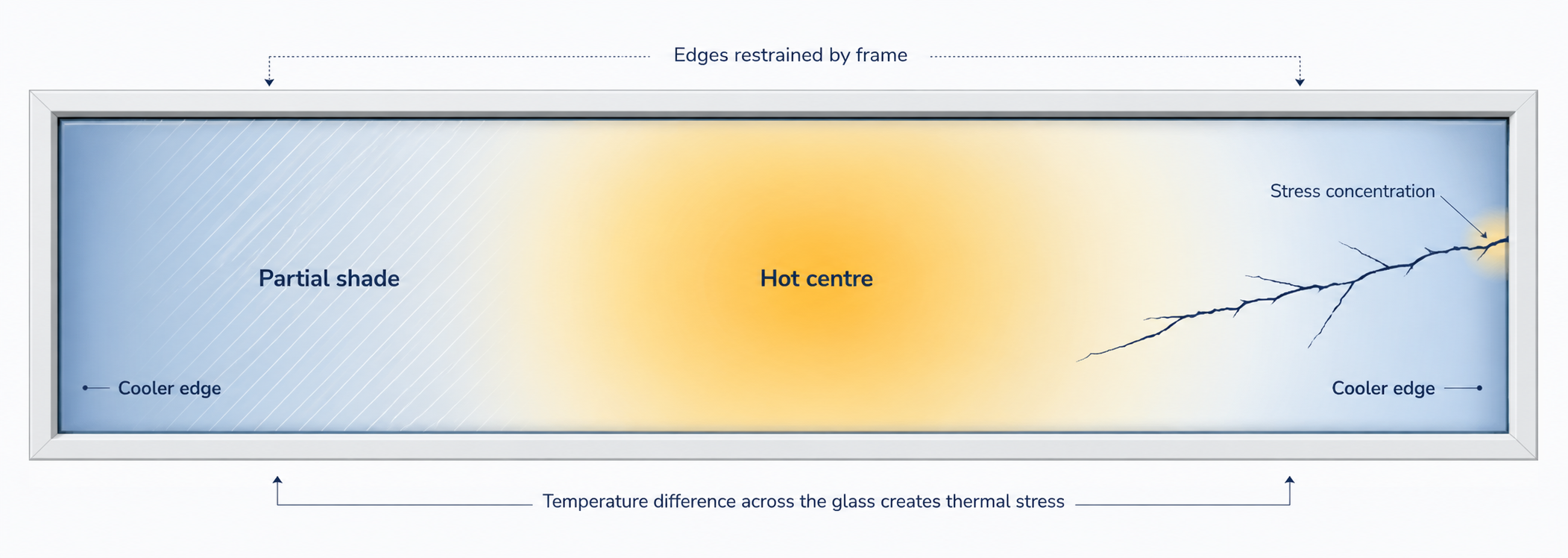
Thermal stress happens when one part of a glass pane becomes hotter than another part.
Glass expands when it heats up. If the centre of the pane heats up more than the edges, stress can build inside the glass. If that stress becomes too high, the glass may crack.
This is why some cracks appear to start from the edge of the glass and travel inward.
The edge is usually the weakest point.
Why window film can affect thermal stress
Window film changes how glass handles solar energy.
Some films reflect more heat. Some absorb more heat. Some allow more light through. Others darken the glass significantly.
A darker or more absorbent film can make the glass heat up more than it did before. On suitable glass, that may be fine. On unsuitable glass, it can increase the chance of thermal stress cracking.
The issue is not simply "tint causes cracks."
The issue is:
The wrong film on the wrong glass can increase thermal stress risk.
That is the more accurate answer.
Factors that increase glass cracking risk
Glass type
Some types of glass tolerate heat stress better than others. Toughened glass, laminated glass, annealed glass and low-E glass can all behave differently with film.
Window size
Large panes can be more sensitive because the centre of the glass may heat differently from the edges.
Partial shading
This is a major one. If part of the glass is in direct sun while another part is shaded by an eave, frame, tree, blind, sticker or furniture, the temperature difference across the pane can increase.
Existing edge damage
Small chips or defects along the glass edge can become starting points for cracks. These defects are often hidden inside the frame and not visible during normal inspection.
Frame condition
Tight, damaged or poorly draining frames can place extra stress on the glass.
Internal blinds and furnishings
Blinds, curtains, furniture or objects placed close to the glass can trap heat and increase temperature differences.
Film type
Dark, highly absorbent or unsuitable films can increase glass temperature more than appropriate alternatives.
How to reduce the risk
The best way to reduce risk is to match the film to the glass.
A professional installer should consider:
- Glass type
- Window size
- Orientation
- Shading
- Existing damage
- Frame condition
- Desired result
- Film absorption and performance data
In some cases, the safest recommendation may be a lighter film, a different film technology, or no film at all.
That may not be the answer a customer expects, but it is better than creating a problem that could have been avoided.
Are darker films more risky?
They can be.
Darker films often absorb more solar energy, which can increase glass temperature. That does not automatically make them unsafe, but it does mean they must be used carefully.
A dark film may be suitable on one window and unsuitable on another window in the same house.
This is why quoting from photos alone can be risky for certain jobs. An onsite assessment gives a better picture of the glass, exposure and surrounding conditions.
Does this mean lighter films are always safer?
Not always, but lighter films are often less thermally aggressive.
Some high-performance films can reduce heat while maintaining a lighter appearance. These are often a better choice where glass compatibility or appearance is a concern.
The right answer depends on the film's full performance profile, not just how dark it looks.
What does a thermal stress crack look like?
Thermal stress cracks often start from the edge of the glass and move inward.
They may appear as a single clean crack rather than a spiderweb impact mark. However, the cause of any glass crack should be assessed carefully. Impact damage, frame pressure, building movement, nickel sulphide inclusions and existing edge defects can also contribute to glass breakage.
Not every crack near tinted glass is caused by the film.
That assumption is too simple.
Can existing glass damage be seen before tinting?
Sometimes, but not always.
Visible scratches, chips or cracks can be identified before installation. Edge damage is harder because the edge of the glass is often hidden inside the frame.
This is one reason glass manufacturers and film manufacturers treat thermal stress as a compatibility issue rather than a simple installation issue.
A clean installation does not automatically mean the glass itself was suitable for every film type.
Why cheap film can be a false economy
Cheap tinting often focuses on darkness and price rather than film performance and glass compatibility.
That can create problems.
A film that is too dark, too absorbent or poorly matched to the glass may increase risk, reduce appearance quality or fail earlier than expected.
The lowest price is not always the lowest cost.
A better film recommendation considers:
- How much heat needs to be reduced
- How much light should remain
- Whether the glass is compatible
- How long the film is expected to last
- Whether the result suits the home visually
How Ultra Tint approaches film selection
Ultra Tint assesses glass before recommending residential window film.
We consider the window's exposure, size, glass type, shading and condition. Where there is a higher thermal stress risk, we recommend a more suitable film or explain the limitation clearly.
We would rather give the right advice than install the wrong product.
That is better for the customer, the glass and our reputation.
If the project is a business, school, medical suite or shopfront, the same compatibility thinking also carries across to commercial window tinting on the Gold Coast.
Summary
Window tint can contribute to glass cracking if the wrong film is installed on unsuitable glass. The main issue is thermal stress, which occurs when different parts of a glass pane heat and expand unevenly.
The risk depends on the glass type, window size, shading, frame condition, existing damage and film selection.
Careful glass assessment and film selection can reduce this risk. A poorly matched film can increase it, regardless of price.
If you are unsure which film is safe for your home, arrange an onsite assessment before choosing a product.
For related advice, see our residential window tinting guidance and our guide to the technical data on window films.
If you are planning tinting for a workplace or tenancy, also review our commercial window tinting Gold Coast page for site-planning and glazing considerations before requesting a quote.
You can also review window tinting FAQs and service areas before booking.
Ready for tailored advice? Book an onsite quote.
FAQs
Can window tint crack double-glazed windows?
It can, depending on the glass unit and film selected. Double-glazed units need careful assessment because heat buildup and seal condition can affect compatibility.
Is reflective film safer than dark film?
Not automatically. Reflective films may reject more solar energy, but suitability still depends on the glass type, absorption, shading and exposure.
Can window film void glass warranties?
In some cases, yes. Some glass manufacturers restrict aftermarket film use. It is important to check the glass warranty and use films that are suitable for the application.
Should I tint old glass?
Old glass can sometimes be tinted, but it should be assessed carefully. Existing defects, brittle frames or hidden edge damage may increase risk.
Is thermal stress covered by workmanship warranty?
Usually not if the crack is caused by glass condition, incompatibility or thermal stress rather than installation workmanship. This should be explained before installation.